Actuator
12 axial layers
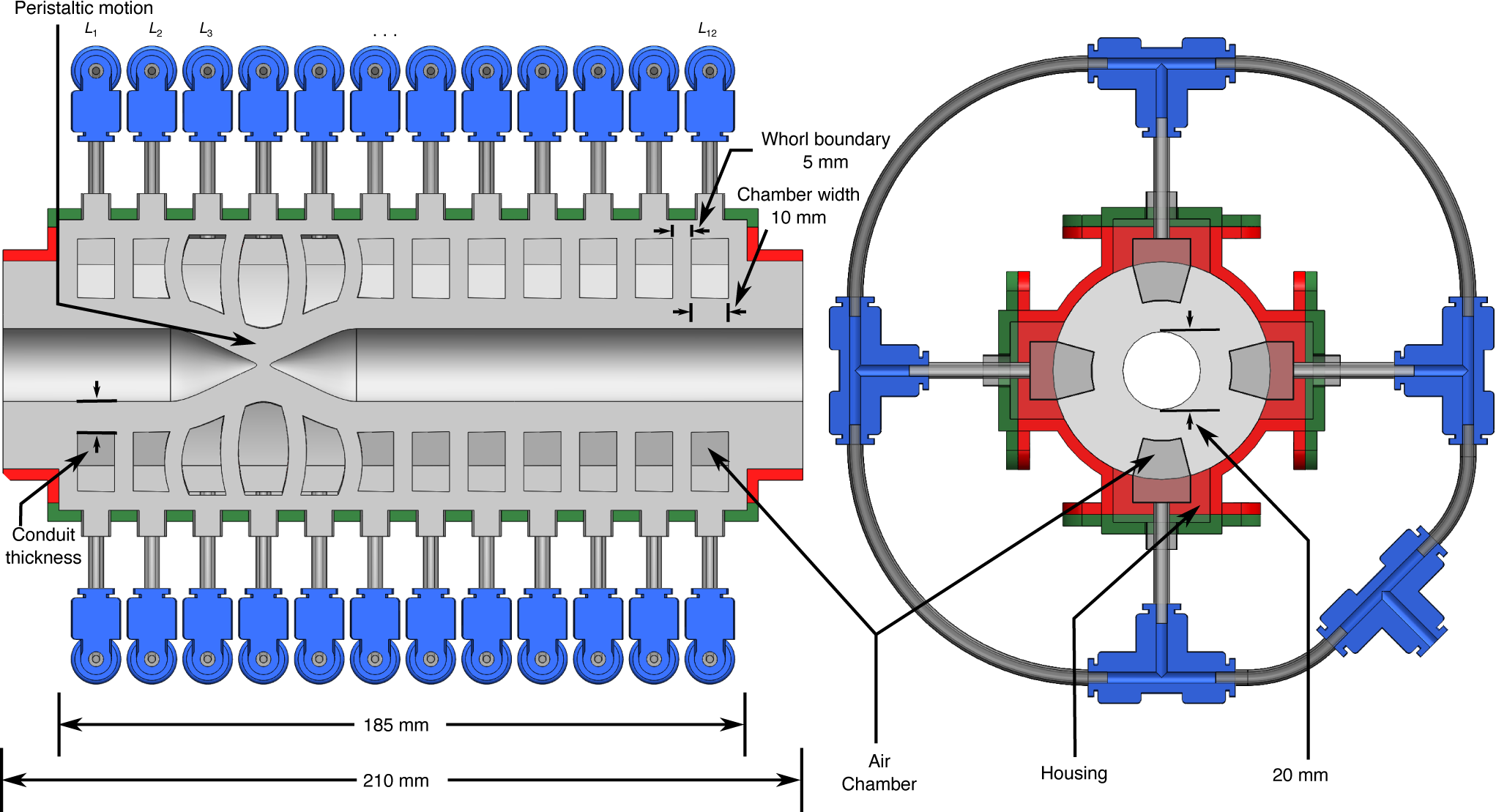
Regular pneumatic whorls (10 mm) stack along 185 mm of actuating conduit. Overlapping sequential pressurization yields continuous occlusion waves.
RoSE
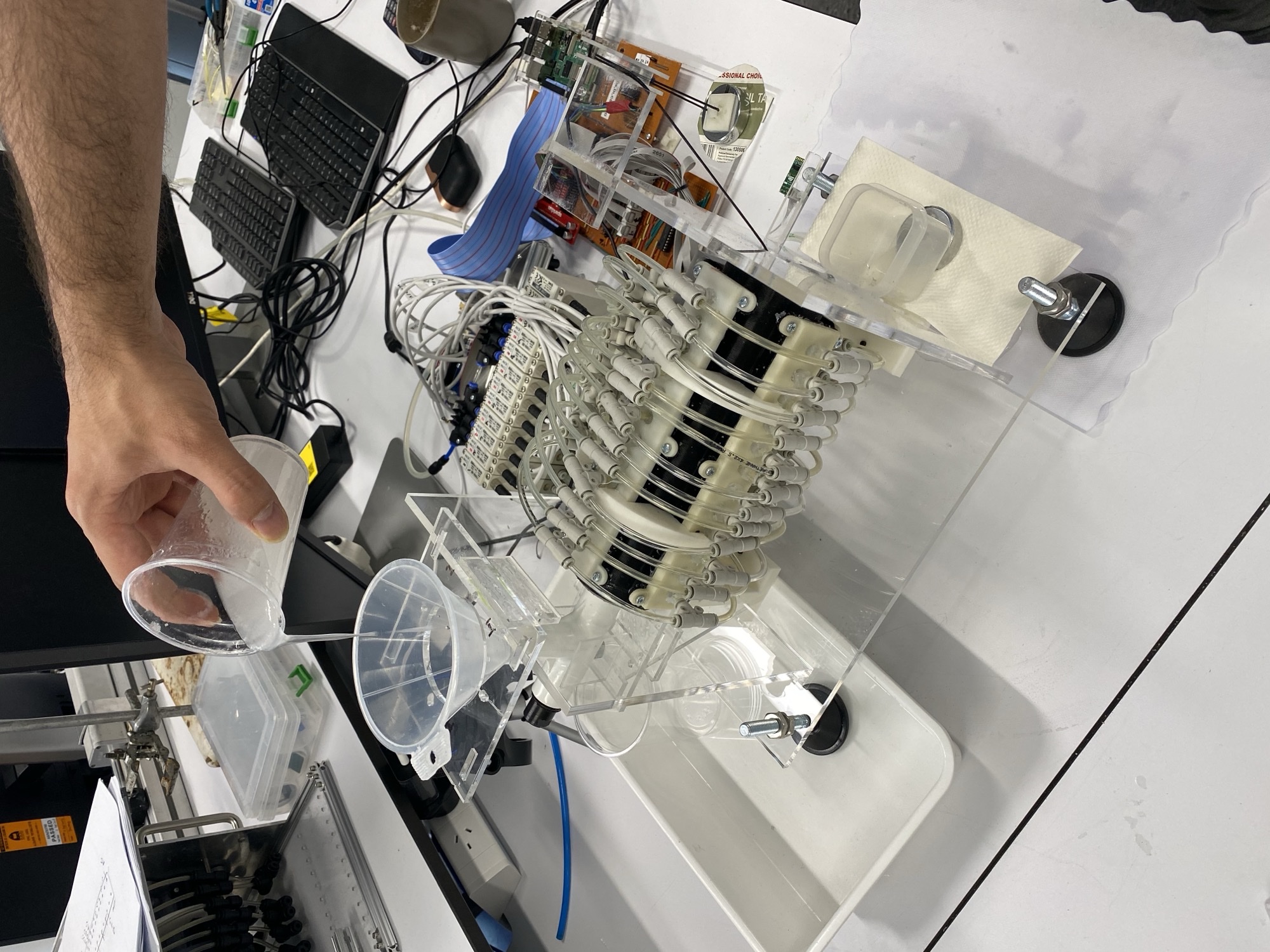
Full benchtop apparatus for forming starch-thickened boluses and transporting them under controlled peristalsis — while measuring stent radial force, migration, and manometric IBPS.
Background
Isometric view. Panel A sketches an esophagus with an implanted covered SEMS holding lumen patency against the wall.
Esophageal stenting is a fast, cost-effective therapy for dysphagia from malignant strictures. Yet 30–50% long-term cases still struggle with migration driven by continuous peristaltic forces.
Radial force (RF) on the wall is pivotal for fixation, but clinical guidance remains thin: few randomized trials, and manometry or fluoroscopy on patients after stenting is ethically and practically constrained. Bench tests (compression, expansion, corrosion) miss the soft, rhythmic environment of a living esophagus.
RoSE closes that gap: a bio-mimicking soft conduit that can impose symmetric contractions or traveling peristaltic waves while you implant commercial stents, measure RF, watch migration, and read intrabolus pressure signatures (IBPS) for texture-modified boluses.
The system
Full experimental setup first — then tap a component to inspect the CAD / paper figures.
Bolus pour. A starch-thickened liquid (texture-modified food simulant) is poured into the inlet funnel to form the bolus that RoSE will transport under peristalsis.
Actuator
Regular pneumatic whorls (10 mm) stack along 185 mm of actuating conduit. Overlapping sequential pressurization yields continuous occlusion waves.
Fig. 2 — Side and top sectional view of robotic soft esophagus (RoSE).
Method
Symmetric loading for RF, peristalsis for migration, and catheter manometry for swallow efficacy. Use the chips to walk each figure.
Deploy. A force-sensing potentiometer (FSP) hoops the stent while all 12 layers inflate and deflate together, tracing hysteresis between resistance and outward force.
Catheter. A 5-sensor motility catheter sits at layer L₄ while starch-thickened boluses (72–144 g·L⁻¹) ride the wave.
TOF marker. A distal paperboard marker and time-of-flight sensor record axial stent travel under sinusoidal waves.
Uniform chamber pressure maps RRF / COF hysteresis and radial stiffness for each stent.
Wave speed and wavelength combine with bolus viscosity to push or reverse stent drift.
IBPS and transported volume reveal when a stiff buckled stent starves bolus transport.
Results
Animated counters and histograms distilled from the Soft Robotics experiments. Stiffer stent B doubles radial stiffness and spikes COF — then buckling can crash bolus volume.
Stent B is roughly twice as stiff as stent A under the same RoSE loading.
Soft stent A stays near 0.33 N; stiff stent B holds ~18 N outward force.
Compliant stent A stretches more, keeping RF on a lower profile.
IDDSI-style starch boluses from syrup-thin (I) to pudding-thick (III).
After buckling, volume collapses for thicker boluses — a mechanical path to recurrent dysphagia.
Each stent sees a 2 × 3 × 3 × 3 design across stiffness, bolus, speed, and wavelength.
Paper figures · guided reading
Tap the chips under a figure to step through the panels and takeaways.
Hysteresis. Loading (RRF) and unloading (COF) do not retrace: the stent can stay soft while expanding yet resist hard when compressed — useful for lumen patency without constant high force.
Normal. Left: an implanted stent remains roughly circular, preserving conduit compliance for bolus passage.
Pressure trace. Spatiotemporal manometry shows IBPS at the bolus tail versus contact pressure once the lumen seals on the catheter.
Sectional cut. The quarter RoSE (QSR) keeps one chamber per layer along the length so the traveling occlusion wave can be filmed from the side — visibility the full conduit hides.
Publication
Soft Robotics, Volume 8, Issue 4 · First published online 4 August 2020
University of Auckland · Riddet Institute · Auckland Bioengineering Institute · MedTech CoRE
Bhattacharya D, Ali SJV, Cheng LK, Xu W. RoSE: A Robotic Soft Esophagus for Endoprosthetic Stent Testing. Soft Robotics. 2021;8(4). doi:10.1089/soro.2019.0205
Supplementary movies
Select a chapter. Movies S1–S3 from the Soft Robotics submission. Movie S3 uses the quarter RoSE (QSR) — a one-fourth axial section — so the peristaltic wave is visible.
Movie S1 — Symmetric contraction